By Ibrahim Kegbegbe
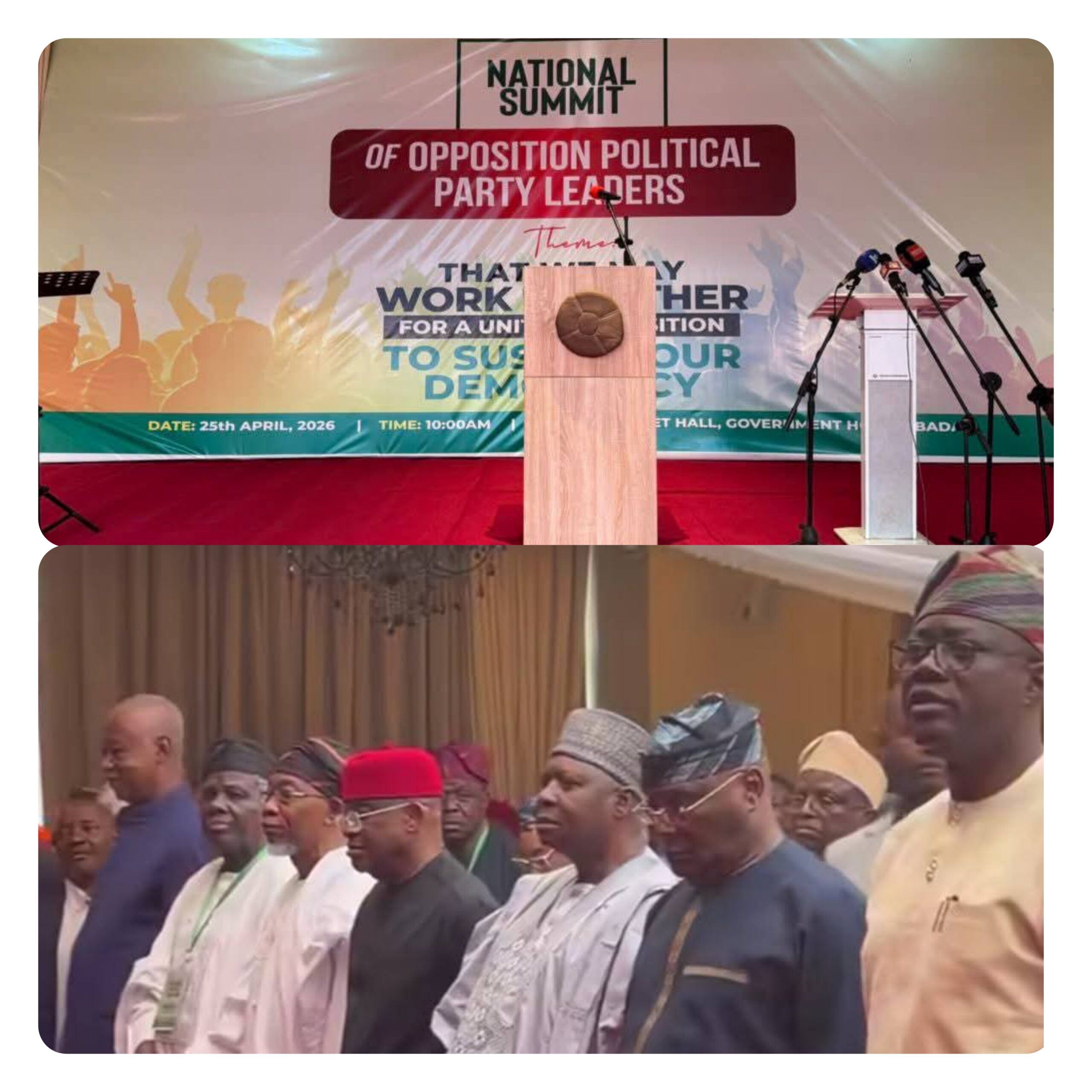
IBADAN — Aspirants across Nigeria’s opposition political landscape have been put on notice following a far-reaching communiqué issued at the end of the Opposition Political Parties National Summit held in Ibadan on Saturday, as leaders resolved to field candidates for the 2027 general elections while working towards a unified presidential flag bearer.

The high-level gathering, hosted in Oyo State, culminated in what participants described as the “Ibadan Declaration,” a document seen as a strategic roadmap for opposition parties seeking to challenge the dominance of the All Progressives Congress (APC) ahead of the next electoral cycle.
The Merit Newspaper reports that in the communiqué, the parties declared their determination to resist what they termed attempts to entrench a one-party state, warning that Nigeria’s democracy must remain plural and competitive. The summit stressed that all opposition platforms would actively participate in the 2027 elections, including the presidential race, despite what they described as “onslaughts and manoeuvrings” by the ruling party.
A central highlight of the declaration is the resolve by opposition leaders to work towards presenting a single presidential candidate in 2027 — a move widely interpreted as an effort to consolidate votes and avoid the fragmentation that has historically weakened opposition chances at the polls.
The communiqué also raised strong objections to the leadership of the Independent National Electoral Commission (INEC), accusing its chairman, Joash Ojo Amupitan, of bias in favour of the APC. The summit called for his removal from overseeing the 2027 elections, citing a loss of public confidence and warning that his continued stay in office could undermine electoral credibility and national stability.
In a related demand, participants urged the National Assembly to urgently review the Electoral Act 2026, identifying provisions they believe could compromise the integrity of the electoral process. The summit further criticized recent guidelines issued by INEC, describing them as restrictive measures aimed at weakening opposition parties, and called for an extension of the deadline for party primaries until the end of July 2026.
Beyond electoral reforms, the communiqué touched on civil liberties, demanding the immediate release of politicians allegedly detained or harassed over bailable offences. The opposition leaders framed this as part of a broader call for inclusivity and the protection of democratic rights.
The summit also acknowledged the resilience of Nigerians amid prevailing socio-economic challenges, commending citizens for their readiness to align with opposition efforts to “rescue the nation from state capture.”
Host governor, Seyi Makinde, and the people of Oyo State received commendation for providing what participants described as a conducive environment for what they termed an “epochal” political convergence.
READ ALSO:Sanitation Drive Returns in Lagos as Eti-Osa East LCDA Leads by Example
Political analysts say the Ibadan summit may signal the early stages of coalition-building ahead of 2027, with the proposed single-candidate strategy likely to dominate political calculations in the coming months. However, questions remain about how competing ambitions among opposition heavyweights will be reconciled.
For aspirants within the opposition fold, the message from Ibadan is unmistakable: while individual ambitions remain valid, the path to electoral success in 2027 may ultimately depend on compromise, coalition, and collective strategy.