By Ibrahim Kegbegbe
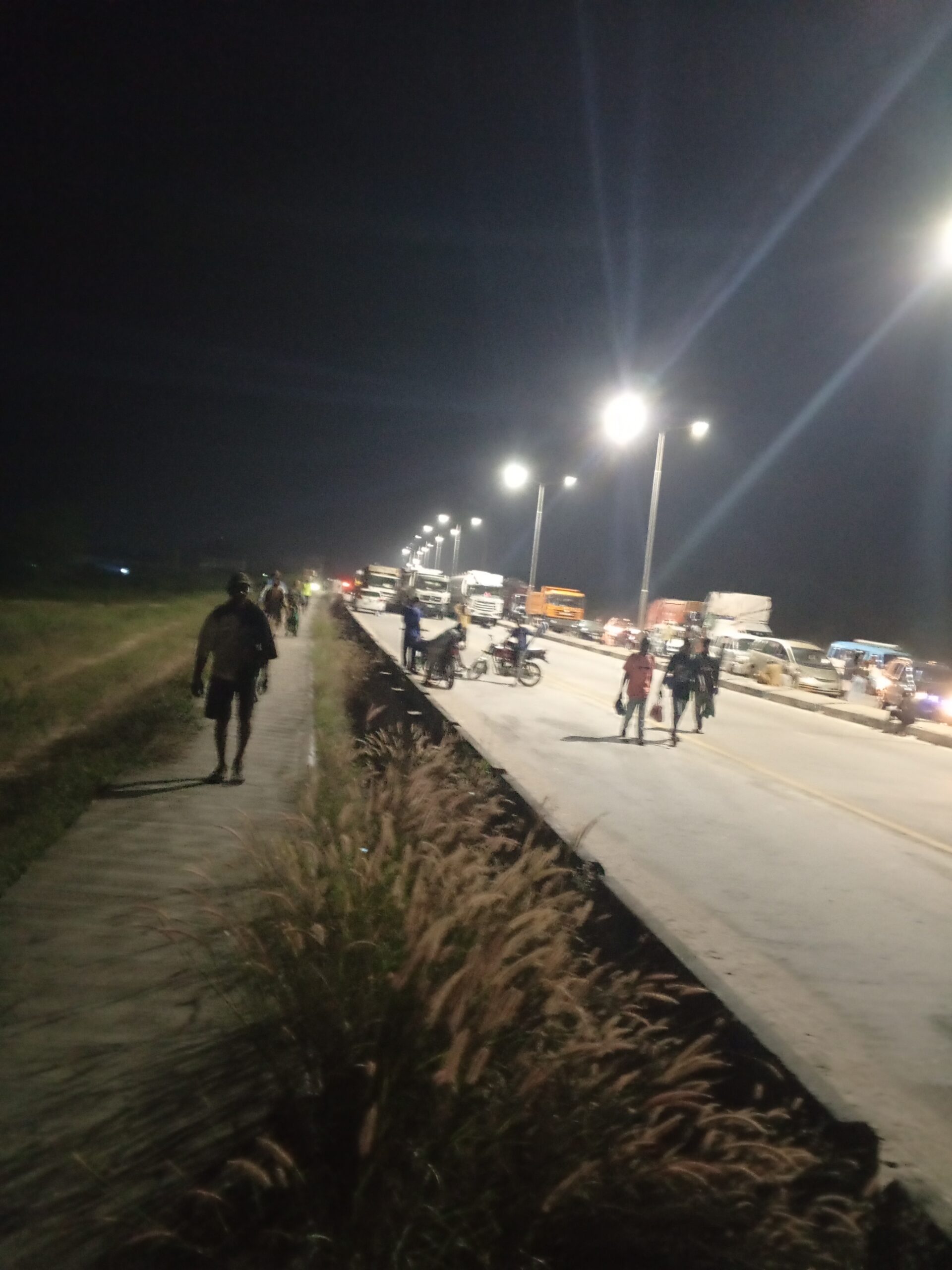
Hundreds of passengers, commuters, and transporters heading to Epe from Ajah were stranded for several hours on Monday evening following a fuel tanker accident that caused a total lockdown on the Ajah–Epe Expressway.
The gridlock, which began around 4:43 p.m., persisted late into the night, leaving motorists and pedestrians trapped on the highway with no immediate relief at the time of filing this report.

The incident occurred at Alaro, Ilamija, along the Epe Expressway—about a 13-minute drive to Epe town—when a fuel tanker reportedly fell and began spilling fuel across the road.
Lagos Firefighters Arrive Early, But Traffic Worsens
Eyewitnesses told The Merit Newspaper that emergency responders arrived shortly after the accident.
“Not more than 30 minutes after the tanker fell, fire service officials arrived and began pouring water on the fuel to dilute it and prevent any fire outbreak,” an eyewitness said.
Despite the swift response, the spillage forced authorities to restrict vehicular movement, triggering a traffic buildup that rapidly spread backwards from the accident scene.
By early evening, the gridlock had stretched as far as the Jesus City bus stop, a popular landmark along the corridor. By 5:25 p.m., information about the blockage had reached the Ajah bus stop, prompting many commercial drivers to stop loading passengers bound for Epe.
This decision left scores of commuters stranded at Ajah, with many unsure of alternative routes or transport options.
Gridlock Reaches Ibeju-Lekki Axis
A Merit Newspaper reporter who arrived at Ajah around 6:00 p.m. observed that the congestion had worsened considerably. By 7:00 p.m., traffic was almost at a standstill around the Oke-Ogun bus stop, shortly after the Ibeju Long Bridge.
With vehicles barely moving, hundreds of commuters abandoned their cars and buses and began trekking towards the accident scene.
“It was a frustrating experience. People were tired, confused, and unsure of how long the situation would last,” the reporter observed.
The reporter eventually reached the scene at about 9:05 p.m., where the situation remained dire.
Total Lockdown on Both Ends
By nightfall, the expressway had become completely impassable.
“There was a total lockdown. No vehicle could move from Ajah to Epe, and none from Epe could navigate towards Ajah,” the reporter noted.
Although the Lagos firefighters had left the scene by then, military personnel were stationed along the road to maintain law and order and to prevent criminal activities, especially against commuters trekking long distances or motorists stranded overnight.
“The presence of security personnel gave some level of reassurance, but people were still very anxious,” a commuter said.
Okada Fare Triples as Commuters Struggle
As desperation grew, commercial motorcycle operators (okada riders) from Epe capitalised on the situation, conveying stranded passengers from Ilamija to Epe town at a steep cost.
Passengers were charged ₦3,000 per person—double the usual ₦1,500 fare for a full car ride from Ajah to Epe under normal circumstances.
“We had no choice. It was either pay ₦3,000 or sleep on the road,” a stranded passenger lamented.
Heavy Trucks Worsen the Situation
Another major challenge observed was the presence of numerous heavy-duty trucks stuck on key bridges linking the expressway to the T-Junction, a critical access point into Epe town.
As of 12:15 a.m. on Tuesday morning, the gridlock had extended to the Ibeju Long Bridge, with some vehicles making U-turns to return to Ajah. On the Epe end, vehicles also turned back due to the overwhelming congestion, dominated largely by articulated trucks.
Stranded Passengers Seek Refuge at Jesus City
With night deepening and movement still impossible, some stranded passengers sought temporary shelter at Jesus City, a worship ground near the expressway, where worshippers were already holding a vigil in preparation for New Year’s Eve 31 crossover service.
“At least there was light and people around. Many of us couldn’t continue the journey,” a commuter said.
Background: A Recurrent Traffic Nightmare
The Ajah–Epe Expressway is a major arterial road connecting Lagos Island, Lekki, Ibeju-Lekki, and Epe. Despite ongoing expansion and rehabilitation efforts, the corridor remains prone to traffic disruptions, especially when accidents involving heavy trucks or fuel tankers occur.
Residents and frequent commuters have repeatedly called on authorities to enforce stricter safety regulations for tanker operators and to improve emergency response coordination to minimise prolonged disruptions.
READ ALSO:NNPP’s Southwest Defectors: Traitors or Prophets?
As of the time of filing this report, efforts were ongoing to clear the road, but many commuters remained stranded, hoping for traffic movement or alternative interventions.