By Ibrahim Kegbegbe
Political parties do not collapse only when they lose elections. Sometimes, they collapse quietly—through defections, internal drift, and the gradual loss of ideological purpose. The New Nigeria Peoples Party (NNPP) appears to be entering that dangerous phase.
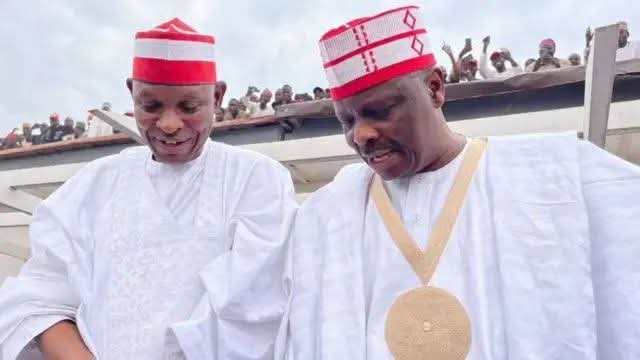
Reports that the party’s national leader and most influential political figure, Rabiu Musa Kwankwaso, is weighing a possible move to the African Democratic Congress (ADC), coming at the same time as indications that Kano State Governor Abba Kabir Yusuf, the NNPP’s only sitting governor, may soon defect to the ruling All Progressives Congress (APC), raise a fundamental question: what remains of the NNPP beyond its red caps?
Kwankwaso is not just another politician within the NNPP. He is the NNPP. The party’s sudden relevance in the 2023 general elections—particularly in Kano—was built almost entirely on his political structure, personal brand, and decades of grassroots mobilisation. Abba Kabir Yusuf himself rose to the governorship as Kwankwaso’s political godson, having served as commissioner for Works, Housing and Transport under Kwankwaso’s administration between 2011 and 2015.
If the godfather is considering one political exit while the godson is plotting another, it is no longer speculation to say that unity has evaporated within the NNPP.
Political parties are sustained by three pillars: ideology, structure, and loyalty. The NNPP, critics argue, has always struggled with the first two and is now visibly losing the third. What ideological position does the party occupy beyond opposition to the political mainstream? What national structure does it command outside Kano? And what loyalty can be sustained when its highest-ranking office holder is seeking shelter under the ruling party, while its most celebrated figure explores alternative platforms?
These are not trivial questions. They cut to the heart of Nigeria’s recurring political problem—parties as vehicles, not institutions.
The NNPP’s red cap, once a symbol of populist resistance and northern political awakening, now risks becoming a hollow brand identity—worn more for nostalgia than conviction. If those still clinging to the party remain not because of shared vision but because of attachment to a symbol, then the NNPP risks joining the long list of Nigerian parties remembered more for aesthetics than achievements.
READ ALSO:U.S. Seals $16bn Africa Health Pacts, Nigeria Leads
Defections themselves are not new in Nigerian politics. What is new—and troubling—is the directionless nature of these movements. When a party’s only governor finds greater political security outside his platform, it signals a failure of internal cohesion. When its national leader begins to search for relevance elsewhere, it suggests the party has outlived its utility to even its founders.
For the Nigerian electorate, this moment offers an important lesson. Political loyalty built around individuals rather than institutions is fragile. Parties without internal democracy, ideological clarity, and long-term vision will always be temporary shelters, easily abandoned when political weather changes.
READ ALSO:APC Members Push Bankole for Eti-Osa Assembly Seat
If Kwankwaso leaves, the NNPP loses its soul.
If Abba Yusuf defects, it loses its last proof of executive relevance.
If both happen, what remains is a party defined not by purpose, but by memory.
And memories, like red caps without direction, cannot govern.
Ibrahim Taofeek Kegbegbe is a journalist and a public affairs analyst