By Ibrahim Kegbegbe
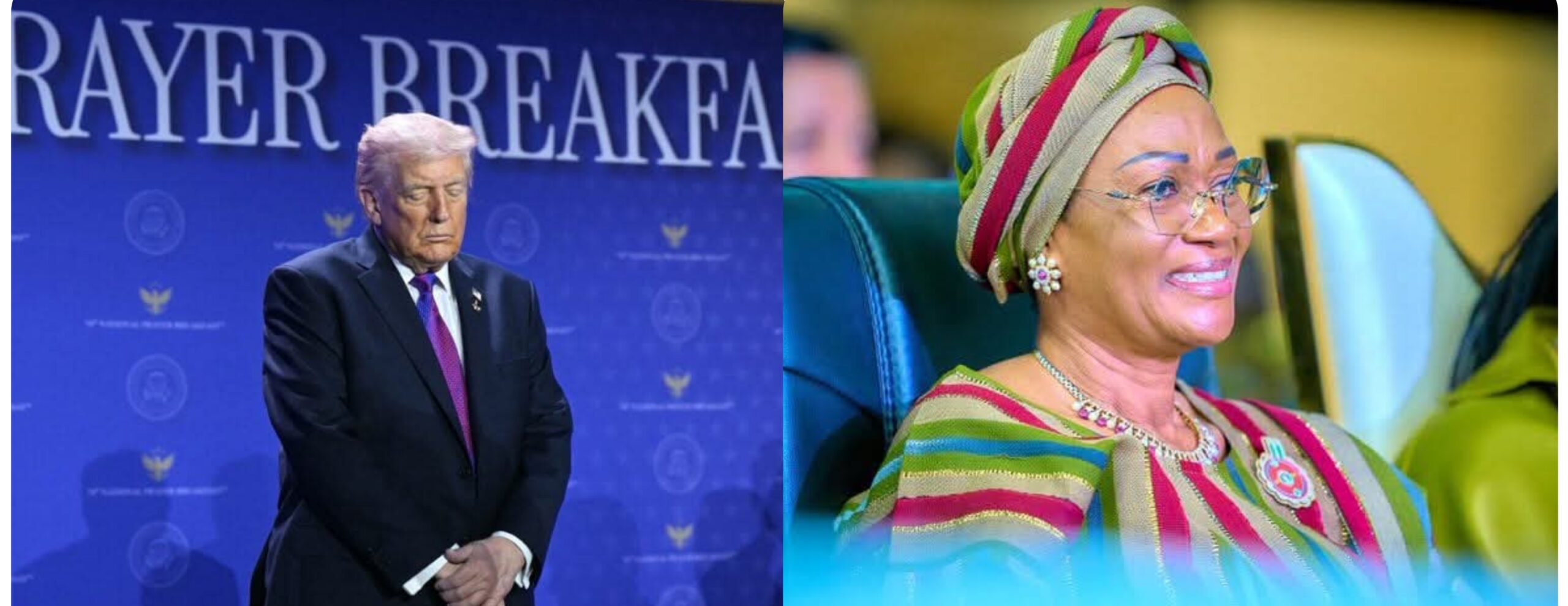
When U.S. President Donald Trump publicly acknowledged Nigeria’s First Lady, Senator Oluremi Tinubu, at the National Prayer Breakfast—describing her as a respected Christian pastor and faith leader—it marked more than a ceremonial diplomatic gesture. Delivered at a globally symbolic forum where faith intersects with power, Trump’s remarks signalled a deliberate shift in tone toward Nigeria, suggesting strategic engagement rather than political antagonism, and security cooperation rather than any intent to destabilise President Bola Ahmed Tinubu’s government.
Only months earlier, Trump was reported to have described Nigeria as “a disgrace” under President Tinubu. Yet at the Prayer Breakfast, he openly recognised Senator Tinubu, commended her spiritual leadership, and thanked her before an international audience. In diplomacy, especially at that level, such symbolic reversals are rarely accidental. They often precede policy recalibration.

READ ALSO:Donald Trump Sworn in as 47th U.S. President, Promises a ‘Golden Age’ for America
The choice of venue matters. The National Prayer Breakfast is not merely a religious gathering; it is a soft-power platform where geopolitical signals are quietly exchanged. Trump’s decision to single out Nigeria’s First Lady in that space reflects a broader U.S.
approach—particularly under his leadership—where faith-based diplomacy functions as a gateway to political and security cooperation. Acknowledging Senator Tinubu as a faith leader subtly elevates Nigeria’s standing as a moral and stabilising force in a turbulent region.
Predictably, critics have rushed to link Trump’s praise to Nigeria’s reported $9 million engagement of U.S. Republican lobbyists. While lobbying is neither illegal nor unusual in Washington, reducing Trump’s remarks to lobbying optics misses the bigger picture. The more relevant question is not who paid lobbyists, but what the United States currently needs from Nigeria in an increasingly unstable global order.
READ ALSO:South Korean President Yoon Suk Yeol Arrested Following Martial Law Controversy
The answer is security—not regime change.
Contrary to speculative narratives circulating in political circles, there is no credible evidence that any Trump-led U.S. strategy toward Nigeria is aimed at unseating President Tinubu. On the contrary, Washington’s growing anxiety over terrorism, transnational crime, piracy, and instability across West Africa makes continuity in Nigeria’s leadership far more attractive than engineered uncertainty.
Nigeria remains Africa’s most populous nation, a major energy producer, and a strategic anchor in the Gulf of Guinea. As insecurity worsens—from banditry and kidnappings to extremist violence spilling across borders—the United States has more to gain by strengthening Nigeria’s internal security capacity than by weakening its political institutions. Stability, not disruption, serves American interests.
Seen through this lens, Trump’s warm words for the First Lady were not personal flattery. They were political signals—signals of engagement, reassurance, and alignment. By publicly recognising Senator Tinubu’s moral and religious influence, Trump indirectly affirmed Nigeria’s institutional stability at a time when global powers are recalibrating alliances based on security reliability rather than ideological affinity.
Trump’s second term, controversial as it remains globally, has produced indirect benefits for Nigeria in the areas of diplomacy and security engagement. His administration’s hardline stance against terrorism, preference for bilateral deals, and emphasis on transactional partnerships have created space for pragmatic cooperation rather than moral grandstanding.
READ ALSO:Councillors’ Forum Endorses Tinubu’s 2027 Re-election Bid, Cites Grassroots Reforms
For Nigeria, this approach offers an opportunity to negotiate concrete outcomes—intelligence sharing, defence partnerships, and counterterrorism support—without the constant threat of diplomatic isolation. Trump’s public recognition of Senator Remi Tinubu, herself a former legislator and influential religious figure, also reinforces Nigeria’s soft power in Washington, projecting moral authority and continuity when global confidence is crucial.
Symbolism, in international relations, often precedes substance. Trump’s acknowledgment of Nigeria’s First Lady at a global religious forum sends a clear message: Nigeria is not being sidelined; it is being engaged. That engagement may be strategic and self-interested, but it is engagement nonetheless.
This does not absolve the Tinubu administration of its responsibility to confront insecurity at home. Killings, kidnappings, and economic hardship remain unacceptable realities for Nigerians. Yet foreign partnerships—especially with a power like the United States—are tools. Whether those tools are wasted or effectively deployed depends on leadership choices in Abuja.
Trump’s praise of Remi Tinubu should therefore not be dismissed as coincidence or reduced to transactional politics. It reflects a broader reality: the United States needs a stable Nigeria more than it needs a destabilised one. Those predicting external plots to remove President Tinubu may be misreading the moment.
In global politics, interests outweigh emotions. And for now, America’s interest lies not in removing Nigeria’s leadership, but in ensuring it survives long enough—and strong enough—to secure Africa’s most critical nation.
Ibrahim Taofeek Kegbegbe is a Lagos-based journalist and public affairs analyst.