By Ibrahim Kegbegbe
The Chairman of the Independent National Electoral Commission (INEC), Prof. Joash Amupitan, SAN, has clarified the reasons behind the Commission’s decision to appeal two recent Federal High Court judgments that challenged aspects of its Timetable and Schedule of Activities for the 2027 General Election.

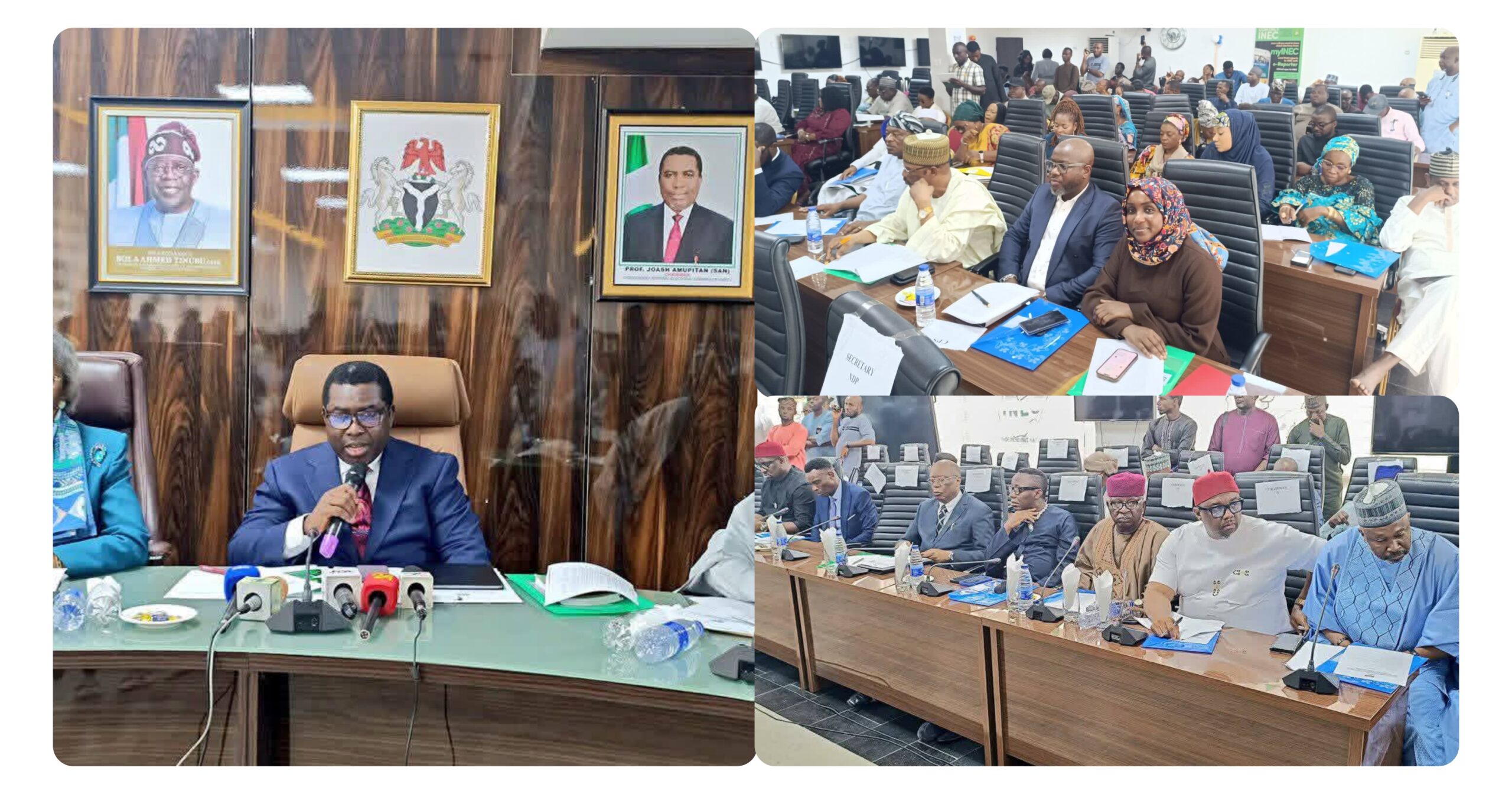
Speaking on Tuesday, 9 June 2026, during his opening remarks at the Second Quarterly Consultative Meeting with Leaders of Political Parties held at the INEC headquarters in Abuja, Amupitan said the appeals were necessary to prevent uncertainty in the electoral process and protect the Commission’s constitutional mandate.
According to him, the absence of a harmonised electoral timeline could undermine the credibility and efficiency of election planning in the country.
He referenced Suit No. FHC/ABJ/CS/517/2026 — Youth Party v. INEC, delivered on 20 May 2026, in which the court questioned certain elements of INEC’s timetable. He also cited a second case, Suit No. FHC/ABJ/CS/720/2026 — Social Democratic Party (SDP) v. INEC, delivered on 26 May 2026, which affirmed INEC’s authority to issue an electoral timetable but invalidated some timelines relating to candidate nomination and substitution.
“These judgments raise important legal questions concerning the extent of the Commission’s constitutional and statutory powers in coordinating and regulating electoral activities,” he said.
Amupitan explained that INEC had already filed appeals in both cases, seeking definitive interpretations from appellate courts. He stressed that the activities outlined in the timetable are interconnected operational processes essential for credible elections.
He noted that several key electoral tasks are not explicitly assigned statutory deadlines under the Electoral Act but are still crucial to election preparation. These include verification of party membership registers, monitoring of party primaries nationwide, pre-upload of primary results on INEC’s portal, printing of ballot papers and result sheets, quality assurance processes, configuration of BVAS devices, and statutory inspections of election materials as provided under Section 42 of the Electoral Act 2026.
READ ALSO:Kwankwaso Signals Reconciliation With Kano Governor Yusuf
According to him, all electoral activities must be properly coordinated within a unified framework that guarantees transparency, efficiency, fairness, and certainty for all political parties.
He assured Nigerians that despite the ongoing litigation, INEC remains committed to conducting the 2027 General Election in strict compliance with the Constitution and the Electoral Act.
Ekiti, Bye-elections and Osun Governorship Update
Turning to upcoming elections, the INEC chairman disclosed that the Ekiti State Governorship Election scheduled for Saturday, 20 June 2026, will have 1,059,360 registered voters. This figure includes 66,664 new registrants added through the Continuous Voter Registration exercise to the 2023 base register of 987,647. He also noted that 2,103 double registrations were removed to safeguard the integrity of the voters’ register.
He added that logistics, technology deployment, and staff training for the election were progressing as planned, with all 2,445 polling units across Ekiti State’s 16 local government areas expected to open simultaneously at 8:30 a.m. on election day.
He further announced that INEC would conduct bye-elections the same day in six constituencies, including Enugu North Senatorial District, Nasarawa North Senatorial District, Rivers South-East Senatorial District, Ondo South Senatorial District, Dawakin Kudu/Warawa Federal Constituency in Kano State, and Zuru State Constituency in Kebbi State. He assured that the same operational standards, technology, and security arrangements for Ekiti would apply to these elections.
The Merit Newspaper reports that Amupitan also reminded stakeholders of the Osun State Governorship Election scheduled for Saturday, 15 August 2026, urging all political parties to strictly follow the established timetable and electoral guidelines.
READ ALSO:Ajadi Celebrates Oyo First Lady Olufunke Makinde on Birthday
Candidate Nomination Portal and Voter Registration
On preparations for the 2027 General Election, he announced that INEC will issue access codes to political parties on Friday, 26 June 2026, for use on its Candidate Nomination Portal. Through this system, parties will upload details of their nominated candidates.
He warned that the portal is fully automated and will close at the end of the stipulated period without extension, urging parties to ensure their ICT teams are fully prepared.
He also encouraged political parties to intensify voter education and mobilise eligible Nigerians to participate in the ongoing Continuous Voter Registration exercise, especially citizens who have turned 18, as well as those seeking corrections or transfers of their voter details.
Call for Political Stability and Electoral Reform
The INEC chairman expressed concern over ongoing court cases involving internal leadership disputes within political parties, describing them as unnecessary distractions and urging parties to resolve such issues internally.
In response, the National Chairman of the Inter-Party Advisory Council (IPAC), Dr. Yusuf Mamman Dantalle, supported INEC’s decision to appeal the court rulings, noting that conflicting judgments had created confusion among political actors, candidates, and stakeholders.
However, Dantalle also called on the National Assembly to review the Electoral Act 2026, citing operational challenges revealed during recent party primaries. He specifically pointed to Section 84(2), which limits parties to consensus or direct primaries, removing indirect primaries.
He argued that the provision has placed excessive pressure on parties and, in some cases, forced controversial consensus arrangements where aspirants were pressured to step down after preferred candidates had been identified by party leaders.
He added that many of these disputes have ended up in court and recalled that IPAC had earlier raised the issue at its General Assembly meeting on 26 February 2026, as well as communicated it to international bodies including the United Nations, European Union, and ECOWAS.
Dantalle further condemned recent political violence in Osun State, urging political actors to adopt peaceful, issue-based campaigns ahead of the Ekiti and Osun governorship elections and the broader 2027 election cycle.
“No political ambition is worth the loss of human life, destruction of property, or destabilisation of communities,” he warned.