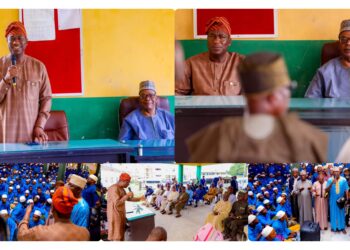


By Ibrahim Kegbegbe
Nigeria’s opposition landscape suffered a major jolt on Saturday as Bauchi State Governor, Bala Mohammed, officially defected from the Peoples Democratic Party (PDP) to the Allied Peoples Movement (APM), intensifying concerns over fragmentation ahead of the 2027 general elections.

Mohammed’s defection, announced after a series of closed-door consultations with political allies and stakeholders, marks one of the most significant realignments within the opposition bloc in recent months.
The governor, a former chairman of the PDP Governors’ Forum, cited the party’s protracted internal crisis and leadership disputes as key reasons for his exit.
“After wide consultations and careful consideration, I have made the decision to move to a more stable and forward-looking platform,” Mohammed said in a statement.
READ ALSO:Binani’s Shock Defection: ADC to NDC in Months
“The situation in the PDP, particularly the lingering leadership crisis, has made it difficult to guarantee a cohesive and winning structure going forward.”
Crisis-Driven Exit
The PDP has been grappling with deep internal divisions, worsened by legal battles over its leadership structure and the aftermath of contentious party congresses. Insiders say recent judicial pronouncements further complicated reconciliation efforts, leaving key stakeholders uncertain about the party’s direction.
The Merit Newspaper reports that Mohammed’s departure is widely seen as a direct fallout of these unresolved disputes, which have continued to weaken the PDP’s position as Nigeria’s main opposition party.
READ ALSO:Wike Ally Onor Enters PDP Presidential Race
Political observers note that his exit underscores a growing pattern of high-profile defections, raising questions about the party’s readiness for the next electoral cycle.
Strategic Move Ahead of 2027
In his declaration, Mohammed described his switch to APM as a “strategic repositioning” aimed at building a viable alternative platform capable of competing effectively in 2027.
Sources close to the governor revealed that the move was not a solo decision but one backed by a significant portion of his political structure in Bauchi State, suggesting a potential shift in grassroots alignment.
“This is not just about me; it is about providing a credible direction for our supporters and ensuring we remain competitive in the evolving political landscape,” he added.
The APM, though relatively less dominant nationally, is increasingly being viewed as a neutral ground for politicians seeking to avoid the entrenched crises in larger parties.
READ ALSO:2027: Kogi Central Women Purchase ₦20m APC Senate Form for Bello
Implications for Opposition Politics
Mohammed’s defection adds to a growing list of political realignments that have reshaped Nigeria’s opposition space in recent months. Analysts warn that rather than consolidating forces against the ruling All Progressives Congress (APC), opposition figures appear to be dispersing across multiple platforms.
This trend, they argue, could ultimately weaken any coordinated effort to challenge the APC’s dominance in 2027.
A senior political analyst in Abuja, who spoke on condition of anonymity, described the development as “a symptom of a deeper structural crisis within the opposition.”
“What we are seeing is not coalition-building but fragmentation. Every major player is seeking a separate path, and that could play directly into the hands of the ruling party,” the analyst said.
2027 in Focus
With less than two years to the next general elections, the race for political positioning has intensified, with defections, alliances and new party strategies unfolding at a rapid pace.
For Mohammed, the move signals both a break from the past and a gamble on a new political future. For the PDP, it represents yet another setback in its struggle to maintain cohesion.
As the countdown to 2027 continues, one thing is becoming increasingly clear: Nigeria’s opposition may be vocal in its ambition to unseat the APC, but its internal divisions could prove its greatest obstacle.