
By The Merit Newspaper
As Nigerian pilgrims began their spiritual journey to Saudi Arabia on May 3, 2026, in preparation for Hajj, the nation once again enters a sacred season — the days of Dhul Hijjah, culminating in Eid al-Adha, the Festival of Sacrifice. This year’s Eid is expected to fall on May 27, subject to the sighting of the moon. It is a period that embodies obedience, sacrifice, charity, and profound reflection for Muslims worldwide.

Eid al-Adha commemorates the profound faith of Prophet Ibrahim (AS), who was willing to sacrifice his son in obedience to Allah’s command. This test was ultimately replaced with a RAM test. In remembrance, Muslims who are financially capable perform Qurbani, slaughtering animals and sharing the meat among family, friends, and the less privileged.
However, as this sacred observance approaches, Nigeria finds itself at a crossroads — one that demands not only religious devotion but also practical wisdom.
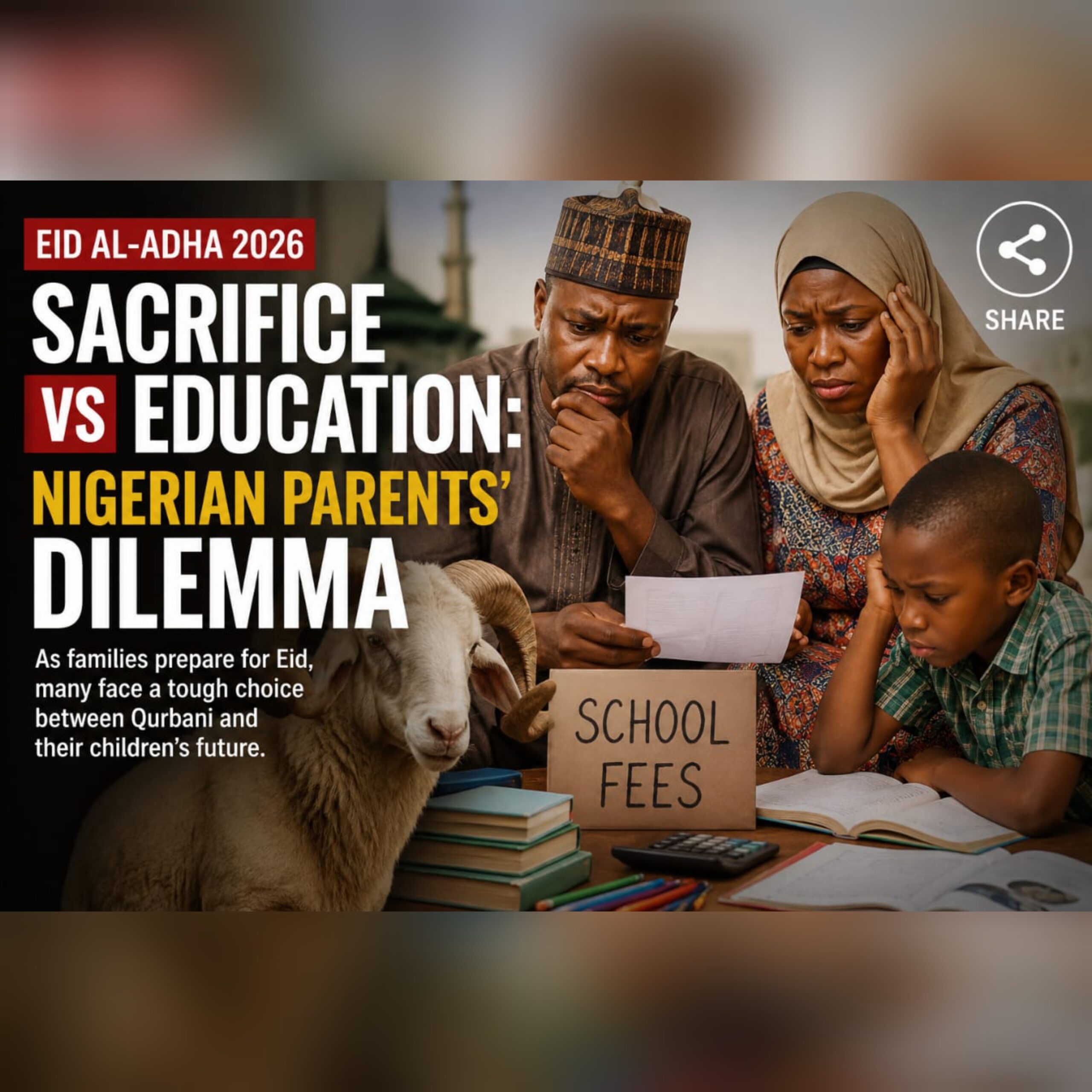
This year, Eid al-Adha coincides with a period that is particularly demanding for Nigerian families. Schools across the country have resumed for the third term — a crucial academic phase that determines whether students are promoted to the next class. For many parents, this term comes with the burden of paying school fees, purchasing books, uniforms, and meeting other educational expenses.
READ ALSO:Arsenal End 20-Year Wait, Reach Champions League Final
At the same time, Nigeria’s economic reality remains harsh. Inflation continues to rise, the cost of living is high, and many households are struggling to meet even basic needs. In such a climate, the question must be asked: what truly constitutes sacrifice?
Islam, as a religion, is built on ease, compassion, and intention — not hardship for its own sake. The act of Qurbani is highly recommended for those who can afford it, but it is not meant to push families into financial distress or compromise essential responsibilities. The essence of Eid al-Adha lies not merely in the slaughtering of animals, but in submission to Allah, sincerity of heart, and care for humanity.
READ ALSO:Tinubu Meets Global Investors in France, Tour Begins
We believe it is both logical and necessary to confront a sensitive but important issue: should a parent prioritise the purchase of a RAM over the education of their child?
In today’s Nigeria, where the future of many children already hangs in the balance due to systemic challenges in education, sacrificing school fees for the sake of ritual slaughter raises serious moral and societal concerns. Education is not just a personal investment; it is a collective necessity for national development. A child denied education today risks becoming a burden on society tomorrow.
READ ALSO:Ebonyi Engineers: Wives Reject Umahi’s “Communal Crisis” Claim
Islamic teachings do not endorse negligence of responsibility. Rather, they emphasise accountability, balance, and foresight. A parent who ensures that their child receives quality education is, in many ways, making a greater and more lasting sacrifice — one that aligns with the broader objectives of preserving intellect, dignity, and future stability.
Across Africa, similar economic realities persist. From Lagos to Nairobi, from Accra to Johannesburg, families are grappling with the tension between religious observance and economic survival. It is in such times that the true spirit of sacrifice must be redefined — not abandoned, but elevated.
Let it be clearly stated: this is not an argument against Eid al-Adha or Qurbani. Far from it. The festival remains a cornerstone of Islamic faith and identity. However, it is a call for introspection — a reminder that sacrifice is not measured by the size of the ram, but by the wisdom of our choices and the impact of our actions.
We urge parents to resist societal pressure and cultural expectations that equate piety with public display. Islam does not demand extravagance; it encourages moderation. If purchasing a ram means a child will be sent home from school due to unpaid fees, then the spirit of Eid has already been compromised.
READ ALSO:Sanusi, El-Ilory, Obasa Photo Stirs Interest
As Nigerians prepare for Eid al-Adha in 2026, this should be a season not only of celebration but of conscious decision-making. We must remember that the greatest legacy parents can leave for their children is not meat shared for a day, but knowledge that sustains them for a lifetime.
In redefining sacrifice, we may yet rediscover the true meaning of Eid.